 THE MONACO GRAND PRIX LIBRARY BY ROY HULSBERGEN THE MONACO GRAND PRIX LIBRARY BY ROY HULSBERGEN |
|||||||||||||||||||||||||||||||||||||||
  |
|||||||||||||||||||||||||||||||||||||||
| Tweet | |||||||||||||||||||||||||||||||||||||||
Jean-Pierre Maurice Georges Beltoise GP's contested: 86 (1966 till 1974)
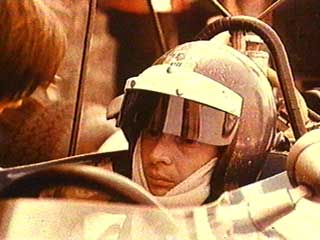
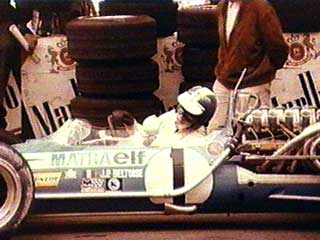
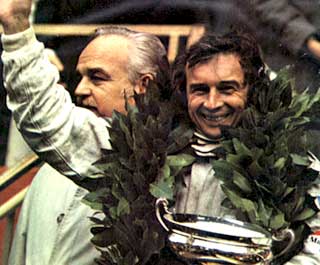
Racing cars and car racing were Jean-Pierre Beltoise’s pan since his schoolboy years. His first “racing car” was his parents' Peugeot 203 delivery van on which he practised his cornering skills, late braking, heel-and-toeing etc., while delivering products from the family’s butcher’s shop. He insisted that he must be paid for his quick delivery talents, so that he could fulfil his racing ambitions. His idea was to start with racing motorcycles, which would be less expensive than getting into car racing, and only a few month after his 18th birthday, he bought a well worn 125cc Jonghi. Despite intensive personal tuning, the bike was completely uncompetitive, but soon a more competitive bike enabled him to display such talent that he soon became one of France’s most sought after riders, successful in all classes from 50 to 500cc, under contract from Kreidler and Bultaco. In the early sixties, he was part of the “Continental Circus” a multiple champion of France and probably the country’s best rider. A good motorcycle racer usually quickly adapts to car racing and in 1963, René Bonnet of DB-Panhard fame decided to try that fast motorcyclist. Having parted from his former partner, Charles Deutsch (the D of DB), he had developed a new car, the “Djet” which was powered by an 1100cc Renault Gordini engine located behind the cockpit. In 1963 and 1964, Beltoise alternated successes on bikes and frustration with the underdeveloped “Djet”. The arch rivals in the class were the Alpine-Renault and the Reims 12 hours Race was a good occasion for René Bonnet’s “Djets” to show their newly found reliability and pace. Soon after the midnight start, Beltoise’s “Djet” was harrying Mauro Bianchi’s Alpine when he hit a large patch of oil spilled by a car which had just burst its engine and which he could not see in the darkness. The accident was inevitable. Jean-Pierre was thrown out of the closed car and taken to hospital by helicopter with multiple fractures including a broken femur and 16 fractures of the left arm at elbow level. The arm has remained weak and almost stiff to this day. One year after the accident, Jean-Pierre was only just able to walk (with a stick) and still could hardly use his left arm. Meanwhile, the René Bonnet company had been bought up by Matra, the state owned company producing missiles and various high-tech equipment. Matra was keen to add an automobile branch to its activities and put Jean-Luc Lagardère, a dynamic young manager at its head. He decided to start racing in Formula 3 (1000cc), using Renault engines. He was most dubious that Beltoise could resume racing, but to prove it, Jean-Pierre took part in a motorcycle hill climb at Montlhéry and won two classes! Though he was still not quite convinced, Lagardère gave in and it was Beltoise who gave Matra its first racing victory, against stiff international competition, in the F3 race run as a curtain raiser to the 1965 French GP¨. Matra had more ambitions plans however and with the financial help of Elf, a Formula 1 car was soon under development. Matra wanted to power it with its own V-12 engine, designed by Georges Martin, but Elf was more in favour of using the successful off-the-shelf Ford-Cosworth DFV V-8. Both models were entrusted to Ken Tyrrell to run. Beltoise who had proved to be as fast on four as on two wheels, was chosen to drive the V-12 together with Henri Pescarolo who had also proved himself in Formula 3 and 2, while Jackie Stewart and Johnny Servoz-Gavin were to run the Ford engine cars. In its first year in F1 Matra was very successful, as Stewart won three GPs and finished 2nd in the drivers’ championship, in which Beltoise was 6th. The V-12 was fast but probably too heavy. It was also less reliable than the Ford and in the four year… he remained with Matra, Beltoise never won a Grand Prix, though he twice finished 2nd and four times 3rd. 1971 had been a very unhappy year for Beltoise. In his years with Matra, he also drove in Sports car endurance races which, at the time were just as popular as Formula One and in which the V-12 engine Matras were very competitive (they were to win Le Mans three times in succession from 1972 to 1974). Matra had sent Beltoise to the Buenos Aires 1000km Race where he was lying 6th when the car ran out of fuel and stopped at the exit of a slow bend. The pits were only 500m away, and he decided to push the car to get it refuelled (which would not be allowed to-day). Unfortunately, the pits were on the other side of the road, which he had to cross, still pushing the car. Marshals were out with yellow flags, and he felt safe to do so. Unfortunately, at that moment Ignazio Giunti who was leading the race in a Ferrari was about to lap another car. Both had already lapped the Matra twice, as its driver pushed it near the edge of the road, so they did not take much notice of the flags and were driving quite hard. Mike Parkes who was in front, swerved to get past the Matra without problem but because of the car preceding him, Giunti had not seen it and hit it at high speed. He was killed instantly but Beltoise who was pushing the car escaped miraculously unhurt, and the media immediately pinned him down as the culprit. Rightly or not, following this tragedy, his license was suspended for 3 months by the French Federation, following which the international Authority suspended it for two additional months. By 1971, the V-12 engine Matra had become a bit long in the teeth, which created a bad atmosphere within the team and Beltoise signed with BRM for 1972. The British V-12 engine was also underpowered, but the car handled superbly, enabling Beltoise to secure the 3rd best practice time in the Monaco Grand Prix. On race day, rain fell all day. Beltoise managed a ssuperb start, was first past Ste Dévote, up the ramp to the Casino and drove a superb race, never to be caught. This was to be his only victory in a Formula 1 Grand Prix, but he would probably have scored many others, had he not remained faithful to Matra for such a long time. Beltoise drove for BRM in Formula 1 until and including 1974, but he always went back into a Matra seat whenever his former employer needed him, such as at Le Mans in 1972 and 1974, though he never crewed the winning car. Thereafter, he was content to be an occasional “guest driver” and then switched to production car racing. |
|
||||||||||||||||||||||||||||||||||||||
|
|
|||||||||||||||||||||||||||||||||||||||