 THE MONACO GRAND PRIX LIBRARY BY ROY HULSBERGEN THE MONACO GRAND PRIX LIBRARY BY ROY HULSBERGEN |
|||||||||||||||||||||||||||||||
|
Niki Lauda |
||||||||||||||||||||||||||||||
Born: Austria 22/2/1949 GP's contested: 171 (1971 till 1985)
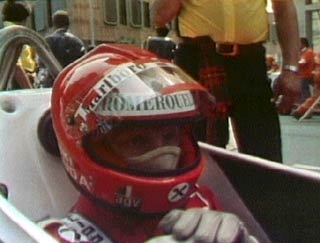
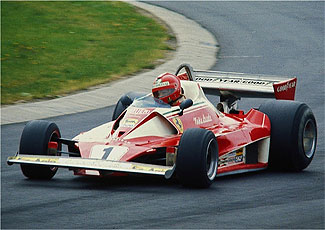
Few could have foreseen the great future ahead of the slow rent-a-driver in the works March at the 1971 Austrian Grand Prix. Yet Niki Lauda's iron determination would eventually win him three World Championships, and bring him back from death's door. Lauda's self-belief was almost the only collateal on the huge loan he took out to pay for a full season of F1 and F2 with March in 1972, and although his F2 results were reasonable, the promise March had shown in 1971 was blunted by over-complex cars and Niki scored no points. Despairing at his future, Lauda managed to buy himself into BRM for 1973. Although the team was no longer the force it had been, Lauda ran well with established star Regazzoni (taking a year away from a moribund Ferrari) and scored enough points to impress the Italian team. Another round of difficult contractual juggling found both BRM drivers at Maranello for 1974, where Lauda found himself able to strike up a close working partnership with dynamic new team boss Luca de Montezemolo. Although Regazzoni was the established star, Niki soon proved himself to be every bit as quick, winning two races, scoring several poles and demonstrating an insatiable appetite and innate skill for testing. The new regime at Ferrari dominated in 1975, Lauda winning five Grands Prix, including a masterful victory in an ailing car at Monaco, on the way to a championship. 1976 seemed set to be more of the same, though Lauda's close friend James Hunt at McLaren promised stiff competition. Lauda was masterful, scoring five wins (one at the expense of a disqualified Hunt), two seconds and a third from the first nine races. Then came the Nurburgring, where Lauda was terribly burned... It was widely assumed that Lauda would die as a result of his appalling injuries; it is equally well-known that it was largely his will to live which kept him alive -- fighting back from what was perceived as being his deathbed. Scarred and nowhere near healed, Lauda returned to the cockpit an amazing six weeks later, to finish a titanic fourth and keep his Championship hopes alive. The crown remained within his grasp until the final race at Fuji; in appalling conditions, he withdrew, handing the Championship to his great friend and rival. A season of operatic drama had ended. For 1977 Lauda was partnered by Reutemann, whom he comprehensively overpowered; Lauda secured the Championship with a tactical drive at Long Beach and stunned the team the next week when he announced that he would be unavailable for the rest of the season; partly for medical reasons, partly a protest at their sacking of his mechanic Ermano Cuoghi (who could not decide whether to follow the new Champion to Brabham) and partly because... he was Lauda. Two seasons with the difficult Brabham-Alfas followed, Lauda's capacity for testing being much-needed by the team, but the only wins coming in '78 in Sweden (the notorious fan-car, a device which appealed to Lauda's technical mind) and at Monza where the first two cars on the road were penalised... Always his own man, Lauda stepped out of the new BT49-Ford after a practice session at the 1979 Canadaian GP and decided he was bored with racing. He walked away from the team and the sport before the end of the season, to concentrate on Lauda Air.Yet Niki was soon back in the cockpit. Whether for financial reasons or because he missed racing, Lauda was a McLaren driver by 1982. His first season brought two wins and fourth place in the Championship. '83 was a difficult year, the Cosworth car gradually falling behind and the TAG Turbo not yet a viable proposition. Everything came right in 1984. Once the formidable TAG-powered car was sorted, Niki was again a force to be reckoned with, five wins and some good placings allowing him to clinch the title by a mere half point from team-mate Alain Prost (who won 7 races). 1985 was the Frenchman's year, though; Lauda suffered a mixture of unreliability and bad luck, and after announcing his retirement at his home GP his only win was taken at Zandvoort. He returned to Lauda Air, which he built into a major business, and was later seen in the pit lanes again as a consultant to the Ferrari team -- now back in the hands of De Montezemolo and giving his precise opinions for German TV. |
|
||||||||||||||||||||||||||||||
|
|||||||||||||||||||||||||||||||
|
|
|||||||||||||||||||||||||||||||