THE MONACO GRAND PRIX LIBRARY BY ROY HULSBERGEN
Jochen Rindt

1942 - 1970

The one and only World Champion posthumus.

Born in Achum on 18th April 1942 from a German father and an Austrian mother, Jochen Rindt became an orphan following a bombing when he was two years old (the age of his own daughter when he died in 1970). He was raised in Austria by family members and Austria became his home.
He has his first driving experience on his way to school in an old VW. Associated to the family business of spice trading, Jochen Rindt celebrates his eighteenth birthday by buying a second hand Alfa Giulietta TI. The following Sunday he races in Aspern and wins against many large Jaguars.
His many successes soon enable him to envisage the purchase of a single seater and it's with a Cooper Junior together with Kurt Bardi-Barry in 1963, that he enters the racing world...

Rindt's first international success is obtained in Italy at Cesanetico in 1963, which is followed by his moving to Great Britain and joining an F2 team with a 1000cc engine and maximum weight of 420Kg. He races Brabham's, and three races are enough to get him known in the international racing world.
At the Nürburgring, Jochen is fourth; behind Clark, Attwood, and Spence.
Eight days later at Mallory Park he outshines Jim Clark by achieving the best time in practice and finishes third; later he wins the London Trophy ahead of Graham Hill, Rees, Arundell and Dennis Hulme.

In Junior F2 and F1, Jochen Rindt continues his progress until he is lent a Brabham BRM by Rob Walker for the Austrian Grand Prix. He is in third position until at the 50th lap a broken steering member ruins his race... but he has shown enough of his talent to be offered a contract by John Cooper to become official driver in 1965.
An unexpected victory at the Le Mans 24 hours race makes him very popular but it's at the wheel of small and agile F2's that bring him glory. With the Winckelman team he establishes himself as an outstanding driver.


Jochen Rindt, photo Ralph D. Edelbach

Finally after Brabham goes to Japan to acquire the miracle engine the Australian team is able to fight. After the arrival on the scene of 1600 cc engines and the monopoly of Cosworth, Rindt dominates even more. Often beating the others, his main battle remains with himself.

Only the right car is missing for Rindt to take off in Formula One. His transfer to Brabham is the first step, and then his transfer to Lotus quickly confirms his talent.

Rindt perseveres until the fatal day in Monza to obtain his ultimate reward.
The 1970 season is well known. Luck that had snubbed the teammate of Hill and then Miles seemed to want to settle. In Monaco, Clermont, at Brands Hatch, Rindt's hard work transformed into well deserved victories. Monaco, his most exceptional race together with the Grand Prix of Belgium and in Clermont...  a circuit he did not particularly like.
In Zandvoort and then in Hockenheim, Jochen imposed his superiority. With 20 points advance he could take it easy, then he went to Monza.
All the witnesses confirm: it was not a driving mistake that caused Rindt's death.

A fearless knight, an infallible driver and an exceptional champion, Jochen takes his crown with him and leaves a memory that has taken its place amongst the greatest champions. He leaves behind his wife Nina and a little girl Natacha...  the child he will never know.

More...


Jochen Rindt's fatal crash.
The front end of the car was destroyed. Although Rindt was rushed to hospital, he was pronounced dead. Rindt had only recently acquiesced to wearing a simple lap belt, and had slid underneath where the belt buckle cut his throat.He was the second Lotus team leader to be killed in two years, as Jim Clark had in 1968. An Italian court later found that the accident was initiated by a failure of the car's right front brakeshaft, but that Rindt's death was caused by poorly installed crash barriers.
On Rindt's fifth lap of the final practice session, Hulme, who was following, reported that under braking for the Parabolica corner: 'Jochen's car weaved slightly and then swerved sharp left into the crash barrier.A joint in the crash barrier parted, the suspension dug in under the barrier and the car hit a stanchion head on.

jochen
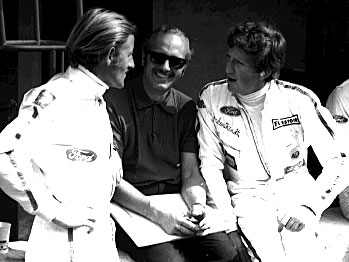
Jochen Rindt with Graham Hill and Colin Chapman in 1969